Good news if you’re planning to buy a real Christmas tree this year: prices should look a lot like last year’s. In its annual survey, the Real Christmas Tree Board found that 91% of wholesale growers don’t plan to raise their wholesale prices for 2026, and 85% rate supply as strong or very strong. Artificial trees, which got 10% to 15% more expensive over the past two seasons because of tariffs and diesel costs, are holding relatively steady for now, WCPO reports.
With Thanksgiving on November 26 and Black Friday right after it, tree lots and store displays are filling up now. Here’s what the latest numbers say about real versus artificial trees, what you’re likely to pay, and how to keep both your budget and your home safe this season.
Christmas Tree Prices in 2026: What the Surveys Show
Real trees: steady wholesale prices and plenty of supply
The Real Christmas Tree Board surveyed 47 wholesale growers in August 2026, a group that supplies roughly half to two-thirds of the U.S. real tree market. Its findings, released September 23:
- 91% of growers don’t plan to raise wholesale prices, up from 84% who said the same in 2025. That figure includes growers who may lower prices.
- 85% rated their 2026 supply as strong or very strong.
- 79% expect to sell the same number of trees or more than last year.
The board notes that growers are largely absorbing higher input costs rather than passing them on to retailers. Keep in mind that wholesale prices aren’t what you pay at the lot. Retailers set the final price, and rent, labor and transport all play a part, so prices still vary by city, tree size and species. Last year’s shoppers seemed fairly happy: in the board’s post-season consumer survey, 91% of real tree buyers said the price was worth it and 56% said they paid less than they expected.
Artificial trees: higher after tariffs, but steady for now
Artificial trees took the bigger hit in recent years. Tariffs and diesel costs pushed prices up 10% to 15% over the past two holiday seasons, but they’re relatively steady right now, according to WCPO’s reporting. Entry-level options are still out there; a Walmart store manager told the station some artificial trees sell for as little as $50.
Demand for artificial trees keeps growing. In a 2026 Consumer Holiday Sentiment survey from National Tree Company, one of the largest importers and wholesalers of artificial trees, 80% of people who celebrate Christmas said they plan to decorate with an artificial tree this year, Chain Store Age reported on November 12. Since the company sells artificial trees, treat its numbers as one side of the story, just as the Real Christmas Tree Board speaks for real tree growers.
The same survey of 1,074 U.S. adults found that:
- 37% don’t plan to buy a tree this year at all.
- 34% of those who are buying plan to spend under $200.
- Households now display almost two trees on average, up from fewer than 1.5 in 2023.
- 63% plan to buy their artificial tree in a physical store rather than online.
Real vs. Artificial Christmas Tree: Which Costs Less?
It depends on how long you keep an artificial tree and what you’d normally pay for a real one. National Tree Company CEO Chris Butler framed it this way to Chain Store Age: “You’re paying $150 to $200 for a real tree that you have to haul out and dispose of at the end of the season, whereas you can buy a great artificial tree for $200 to $300 that will last you five to 10 years.”
Using those figures as an illustration, a $250 artificial tree kept for seven seasons works out to about $36 a year, while a $150 real tree costs $150 every year. But plenty of families pay less than that for a real tree, especially at choose-and-cut farms or big-box garden centers, and a cheap artificial tree that sheds or sags after two seasons is no bargain. WCPO’s take is a fair summary: real trees are usually cheaper than mid- to high-end artificial trees in a single year, but an artificial tree spreads its cost across many seasons.
Other things to weigh besides price
- Time and mess. In the National Tree Company survey, 52% of artificial tree owners expect to spend less than two hours setting up and decorating, while 66% of real tree owners expect to spend more than two hours.
- Storage. An artificial tree needs a dry closet, attic or garage corner for 11 months a year.
- Disposal. A real tree has to go somewhere in January. Many cities run curbside or drop-off tree recycling, so check your local program before you buy.
- The experience. For many families, the smell and the trip to the farm or lot are the point, and no cost math changes that.
How to Save on a Christmas Tree and Holiday Decor This Year
A lot of households are trimming holiday spending. WCPO, citing National Tree Company, reports that 45% of consumers plan to spend less on holiday decor this year and 30% don’t plan to buy any new decorations at all. If that’s you, these steps help:
- Compare before Black Friday. Check several retailers’ prices now so you can tell whether a “doorbuster” is really a deal.
- Measure first. Measure ceiling height and floor space before you shop. Taller trees cost noticeably more, and you’ll want room for a topper and the stand.
- Skip the full replacement. If your current artificial tree is in good shape, new lights, ribbon or a small secondary tree can freshen the room for far less than a new centerpiece tree.
- Buy decor in collections. Butler told WCPO there’s “probably money to be saved” buying a coordinated collection rather than every item separately.
- Shop secondhand. Thrift stores and online marketplaces are good sources of ornaments and vintage decorations. For more low-cost ideas, see our guide to budget home decor ideas.
- Make some of it yourself. Homemade garlands and festive DIY table centerpieces cost little and can be reused every year.
- Stock up after Christmas. The deepest discounts on decorations usually come once the holiday is over, which is the best time to buy for next year.
Christmas Tree Safety: Water, Distance and Lights
Tree fires aren’t common, but they can be serious and fast. Between 2020 and 2024, U.S. fire departments responded to an average of 143 home fires per year that started with Christmas trees, causing an estimated 7 civilian deaths, 13 injuries and $15 million in property damage a year, according to the National Fire Protection Association. Nearly half were caused by electrical problems, and a heat source too close to the tree caused nearly one in four. NFPA also notes that 35% of Christmas tree fires happen in January, as trees dry out.
NFPA’s Christmas tree safety tips come down to a few habits:
- Pick a fresh real tree with green needles that don’t fall off when touched.
- Cut about 2 inches from the base of the trunk before putting it in the stand.
- Add water to the stand every day.
- Keep the tree at least 3 feet from any heat source, like fireplaces, radiators, candles, heat vents or lights, and make sure it isn’t blocking an exit.
- Use lights listed by a qualified testing laboratory, replace strings with worn or broken cords or loose bulb connections, and never decorate the tree with lit candles.
- Turn tree lights off before leaving home or going to bed.
- Get rid of a real tree once it dries out, since dry trees become more and more flammable.
NFPA also says to read the manufacturer’s instructions for how many light strands you can safely connect. If you’re plugging a big display into the wall, it’s worth knowing the difference between a basic power strip and a real surge protector; our explainer on how a power surge protector works covers what to look for.
Frequently Asked Questions
Are Christmas trees more expensive in 2026?
Not at the wholesale level for real trees. 91% of growers surveyed by the Real Christmas Tree Board don’t plan to raise wholesale prices. Retail prices can still vary by location and seller. Artificial trees rose 10% to 15% over the past two seasons but are relatively steady this year, according to WCPO.
Will there be a Christmas tree shortage this year?
Growers don’t expect one. 85% of wholesale growers in the Real Christmas Tree Board survey rated their 2026 supply as strong or very strong.
Is a real or artificial tree cheaper?
In any single year, a real tree is usually cheaper than a mid- to high-end artificial tree. Over several years, an artificial tree you keep for five to 10 seasons usually costs less per year.
When is the best time to buy a Christmas tree?
Many lots and farms open around Thanksgiving weekend, which is November 26 to 29 this year, and the selection is widest early. If you buy early, keep the tree watered daily. For artificial trees and decor, Black Friday sales and after-Christmas clearance tend to offer the best prices.
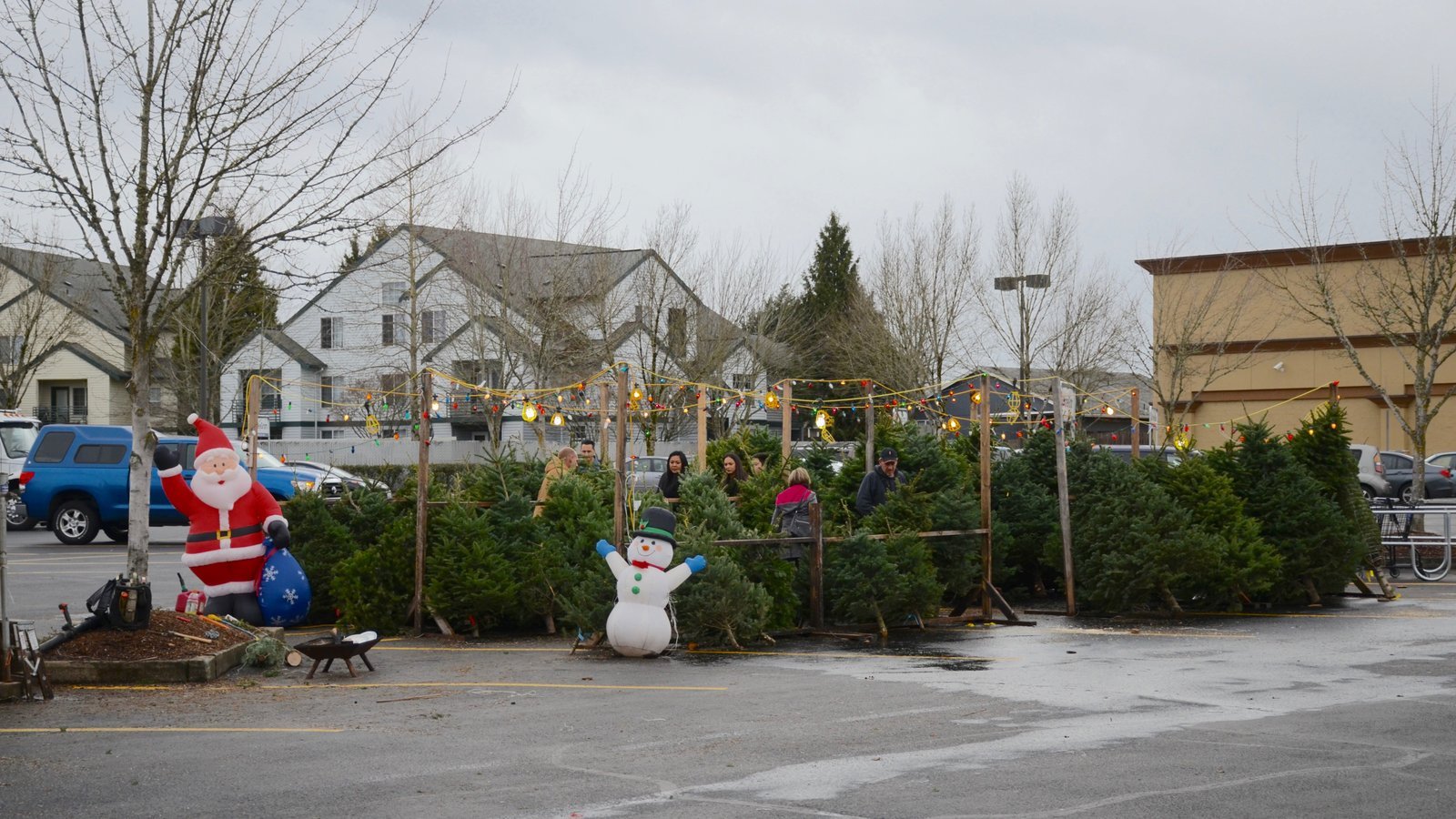
Featured image: “Christmas trees for sale in grocery store parking lot – Hillsboro, Oregon” by Steve Morgan, via Wikimedia Commons, licensed CC BY-SA 3.0. Cropped.